
If your car is making a grinding noise every time you slow down, you’ve probably already started Googling “brake pads vs rotors” to figure out what’s actually wrong. The good news is that most brake problems are not mysterious. The bad news is that a lot of drivers wait too long to deal with them, and that waiting turns a simple fix into a much more expensive one.
Here’s what you actually need to know.
What Brake Pads and Rotors Actually Do
Your braking system works because two key parts work together under enormous pressure and heat. Brake pads are the friction material that clamps down against the rotor every time you press the brake pedal. Rotors are the large metal discs attached to your wheels that the pads grip to slow you down.
Think of it this way: the pads are designed to wear out so the rotors don’t have to. Pads are the sacrificial part of the equation. Rotors are built to last much longer, but they’re not invincible.
Why Brake Pads Wear Out So Much Faster
Brake pads are made from softer friction material, which is the whole point. That material erodes a little bit every time you brake. The harder you brake, the faster they wear. City driving, stop-and-go traffic, and heavy loads all accelerate the wear process considerably.
Most brake pads last somewhere between 25,000 and 65,000 miles depending on the material type, your driving habits, and the vehicle. Some drivers in high-traffic areas find themselves replacing pads far more frequently than that. Others who do mostly highway driving get more life out of them.
Signs Your Brake Pads Are Getting Thin
You don’t always need a mechanic to tell you your pads are worn. Your car will usually give you a few clear signals before things get serious.
- A high-pitched squealing noise when braking is often a wear indicator built into the pad itself. It’s designed to squeal when the pad gets thin enough to warrant attention.
- A grinding metal-on-metal sound means the pad material is gone and the metal backing is now contacting the rotor directly. That’s an emergency.
- Longer stopping distances or a spongy brake pedal can also point to pad deterioration, though these symptoms may have other causes too.
If you’re hearing any of these in Indianapolis, don’t put it off. The longer you drive on worn pads, the more damage you’re doing to the rotors underneath.
What Happens to Rotors Over Time
Rotors don’t just disappear as brake pads do. They wear more slowly, but they wear. Every time the pads clamp down, the rotor surface experiences friction. Over thousands of miles, this creates grooves, scoring, and an uneven surface that reduces braking performance.
The bigger problem is heat. Repeated hard braking without adequate cooling can cause rotors to warp. A warped rotor can cause your steering wheel or brake pedal to vibrate when you slow down. It’s not dangerous the moment it starts, but it gets worse over time and it puts more stress on your brake pads and calipers.
How Thick Is Thick Enough?
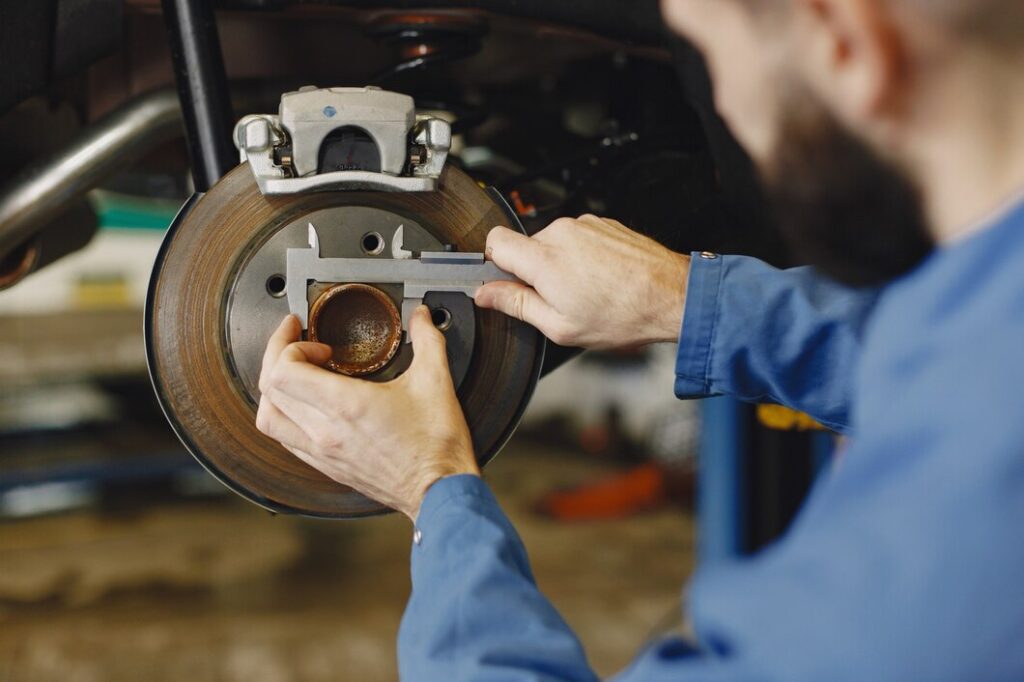
Every rotor has a minimum thickness specification stamped or machined right into the metal. When the rotor wears down below that spec, it no longer has enough mass to absorb and dissipate heat safely. That’s when the rotor needs to be replaced, not resurfaced.
A lot of shops will try to resurface a rotor if it’s still above minimum thickness. Resurfacing can eliminate light scoring and minor unevenness, but it only works when there’s enough material left. If the rotor is at or near its discard thickness, resurfacing just delays the inevitable.
Brake Pads vs Rotors: Do You Need to Replace Both at the Same Time?
This is probably the most common question people ask, and the honest answer is: it depends.
If your rotors are still smooth, properly thick, and showing no signs of warping or deep scoring, you may only need new pads. But if the rotors are grooved, worn thin, or warped, you need to replace them along with the pads. Putting new pads on damaged rotors is like putting new tires on bent rims. You’re setting yourself up for faster wear and reduced braking power.
Most reputable shops – including the team at Grewal’s Automotive – will inspect both components before recommending what actually needs to be done. The goal is to be honest about what’s necessary, not to sell you parts you don’t need.
How Long Should Rotors Last?
In ideal conditions, rotors can last anywhere from 50,000 to 70,000 miles or more. But “ideal conditions” rarely describes real-world driving. Towing, heavy loads, mountainous terrain (not really an Indianapolis concern, but relevant if you travel), aggressive driving, and even the quality of your brake pads can all affect rotor life.
Using cheap or incorrect brake pads is one of the most overlooked reasons rotors wear out prematurely. Low-quality pads can be too abrasive for your rotor material. This is exactly why it matters that a shop uses the correct parts for your specific vehicle – not just whatever’s cheapest on the shelf.
The Hidden Cost of Waiting Too Long
Here’s the math that most people don’t think about until they’re already in the shop.
A set of brake pads might cost $100 to $200 to replace. If you let those pads wear completely down and they start grinding into the rotor, you could be looking at $300 to $600 or more per axle to replace the rotors as well. And in some cases, worn rotors can damage the calipers too, which brings the total cost even higher.
Brake maintenance is one of those things where catching problems early saves real money. It’s not just about safety, though safety is obviously the most important part. It’s about not turning a $150 job into a $700 job because you ignored the squealing for two months.
What a Proper Brake Inspection Actually Covers
When you bring your vehicle in for a brake inspection, a technician should be doing more than just eyeballing the pads through the wheel. A thorough inspection includes measuring pad thickness, checking rotor thickness against manufacturer specs, inspecting rotor surfaces for scoring and warping, checking brake fluid condition and level, and examining the calipers and hardware for proper function.
At Grewal’s Automotive in Indianapolis, brake inspections are part of making sure every customer understands what’s happening with their vehicle before any work begins. Estimates are provided upfront, and nothing is done without explanation. That kind of transparency matters when you’re trusting someone with your brakes.
What Type of Brake Pads Are Best for Your Car?
This is worth understanding because not all brake pads are created equal. There are three main types: organic, semi-metallic, and ceramic.
Organic pads are softer and quieter but wear faster. They’re fine for light-duty driving but may not hold up well under heavy use. Semi-metallic pads offer better heat dissipation and durability but can be noisier and harder on rotors. Ceramic pads are often considered the best all-around option – they’re quiet, durable, produce less dust, and are gentler on rotors, though they tend to cost more upfront.
The right choice depends on your vehicle type, how you drive, and what your manufacturer recommends. A good technician won’t just grab whatever’s in stock. They’ll match the pad material to your specific needs.
Brake Fluid: The Part Everyone Forgets
Brake fluid is hydraulic fluid. When you press the pedal, it’s the fluid that transfers that force to the calipers, which then squeeze the pads against the rotors. Over time, brake fluid absorbs moisture from the air, which lowers its boiling point and reduces its effectiveness.
Old, contaminated brake fluid can cause a soft or spongy pedal feel and increase the risk of brake fade under heavy use. Most manufacturers recommend flushing and replacing brake fluid every two years or around 30,000 miles, though your owner’s manual will have the specific recommendation for your vehicle.
It’s a small service that’s easy to overlook, but it’s a critical part of keeping your entire braking system functioning the way it should.
Driving Habits That Protect Your Brakes
Your behavior behind the wheel has more impact on brake life than almost anything else. Riding the brakes going downhill, braking hard at the last second consistently, and towing heavy loads without adjusting your following distance all shorten the life of pads and rotors considerably.
Coasting down to a stop rather than braking hard, maintaining a safe following distance, and using engine braking where appropriate are all habits that reduce the heat and friction your brakes have to manage. These aren’t just good safety practices – they’re also good for your wallet over the long run.
When to Schedule a Brake Check in Indianapolis
If you’re in Indianapolis and you can’t remember the last time your brakes were inspected, that’s reason enough to schedule one. It doesn’t have to be reactive – you don’t have to wait for squealing or grinding to have a professional look at the system.
A good rule of thumb is to have your brakes checked once a year or every 12,000 miles, whichever comes first. If you tow frequently, drive a lot of city miles, or have an older high-mileage vehicle, more frequent checks make sense. Early detection is always cheaper than emergency repair.
Frequently Asked Questions
Can I replace just the brake pads without replacing the rotors?
Yes, if your rotors are still within spec, smooth, and not warped. A technician should measure them before making that call. If the rotors are damaged or worn below minimum thickness, replacing just the pads is a short-term fix that will create problems quickly.
How do I know if my rotors are warped?
The most common sign is a pulsating or vibrating feeling through the brake pedal or steering wheel when you slow down. This vibration corresponds to the uneven surface of the rotor contacting the pads unevenly as the wheel spins.
Is it safe to drive with worn brake pads?
It depends on how worn they are. Slightly thin pads that are still squealing but haven’t started grinding give you some time – but not much. If you’re hearing metal grinding against metal, you should not drive the vehicle until the brakes are repaired. That’s a situation where stopping distance is seriously compromised.
How long does a brake job take?
A standard brake pad replacement on one axle typically takes one to two hours. If rotors also need to be replaced, add some time. A shop that’s transparent with you will give you an honest estimate before the work starts.
Does driving in the city wear out brakes faster?
Absolutely. Stop-and-go traffic means more frequent braking, more heat buildup, and faster wear on both pads and rotors. Indianapolis drivers who spend a lot of time in city traffic or on busy surface streets will generally need brake service more often than drivers who primarily use highways.
What to Know Before Replacing Brake Pads or Rotors
Brake problems don’t fix themselves, and they rarely get cheaper the longer you wait. Whether you’re dealing with squealing pads, a pulsating pedal, or just a nagging feeling that something’s off, getting a professional set of eyes on your brakes is always the right move.
Schedule a brake inspection with Grewal’s Automotive in Indianapolis by calling 317-886-7501, or learn more about what’s involved by checking out their brake services page.