

If your car has ever shuddered, stumbled, or briefly lost power while driving, you may have experienced a cylinder misfire. It is a common engine problem that can range from a minor inconvenience to a sign of a more serious issue under the hood.
This guide explains what causes an engine misfire, how to recognize the warning signs, and what to do before the problem becomes more expensive to repair.
What Is a Cylinder Misfire?
An engine misfire happens when one or more cylinders fail to complete a proper combustion cycle. In a healthy engine, each cylinder fires in a precise sequence: fuel and air mix together, the spark plug ignites the air-fuel mixture, and the piston moves downward to generate power.
When a cylinder does not complete that process properly, the engine produces uneven power. You can often feel the result while driving or when the engine is idling.
What Does a Misfire Feel Like?
Many drivers describe a misfire as a sudden jerk, stumble, or hesitation, especially during acceleration or while idling at a stoplight.
A misfire can make the vehicle feel as though it briefly loses power before the engine catches itself again. You may also notice rough idling, reduced fuel economy, or an illuminated check engine light.
In more severe cases, you may smell unburned fuel from the exhaust, experience reduced performance, or notice that the engine runs rough consistently rather than occasionally. An intermittent problem can still be serious, especially when it becomes more frequent over time.
Common Causes of an Engine Misfire
Understanding the possible causes of a misfire can help you determine when your vehicle needs professional attention. Some of the most common causes include the following.
Worn or Faulty Spark Plugs
Spark plugs ignite the air-fuel mixture inside each cylinder. Over time, they can wear out, become fouled with deposits, or fail to produce a reliable spark.
When a spark plug cannot ignite the mixture properly, the affected cylinder may not fire as intended. Replacing worn spark plugs is often one of the simplest and most affordable repairs when they are the source of the problem.
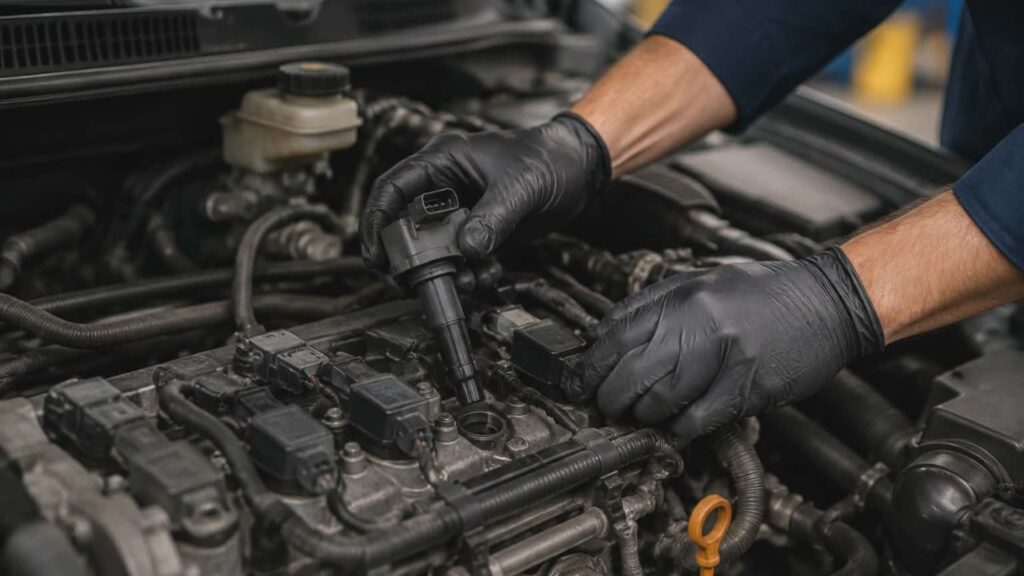
Bad Ignition Coil or Coil Pack
The ignition coil converts battery voltage into the high-voltage spark needed by the spark plug. When a coil fails, the spark plug it supplies may not fire correctly.
Many modern vehicles use an individual ignition coil for each cylinder. As a result, one failed coil can cause one cylinder to run poorly while the others continue operating normally.
Clogged or Faulty Fuel Injector
A fuel injector delivers a precise amount of fuel into the engine. If an injector becomes clogged or develops an electrical problem, the affected cylinder may not receive the fuel it needs for proper combustion.
Because one damaged injector may affect only one cylinder, diagnostic codes often help identify the area that needs inspection. Fuel delivery problems can also reduce fuel economy over time.
Vacuum Leaks
Vacuum leaks can be difficult to identify without proper diagnostic equipment. When a vacuum hose cracks or an intake manifold gasket fails, unmetered air may enter the engine and disrupt the air-fuel mixture.
The engine control unit may try to compensate, but a significant leak can still lead to rough running, hesitation, or cylinder misfires.
Low Compression
Each cylinder needs adequate compression to support proper combustion. If compression is low because of worn piston rings, a damaged valve, or a blown head gasket, the cylinder may not fire correctly.
Compression-related problems are often more serious because they may indicate internal engine wear or damage. Repairs involving valves, piston rings, or head gaskets can be more involved than replacing ignition components.
Sensor and Airflow Issues
Modern engines rely on sensors, including the mass airflow (MAF) sensor and oxygen sensors, to help manage the air-fuel mixture. When a sensor provides inaccurate information, the engine may receive an incorrect mixture, which can contribute to poor performance or misfires.
A dirty air filter may also restrict airflow and affect engine operation. These components are worth inspecting during routine maintenance or diagnostic service.
Why You Should Not Ignore a Misfire
A continuing misfire can lead to more expensive vehicle problems. When fuel is not burned properly inside the engine, it may enter the exhaust system and damage the catalytic converter over time. Replacing a catalytic converter can be much more costly than repairing the original cause of the misfire.
Driving with an active problem may also place additional stress on engine components. The longer the issue continues, the greater the risk that a minor repair could develop into a more extensive engine problem.
A misfire may also cause your vehicle to fail an emissions inspection where testing is required. If your check engine light is on and the onboard diagnostics system has stored active misfire codes, your vehicle should be inspected before the issue worsens.
How to Diagnose and Fix an Engine Misfire
Diagnosing a misfire usually begins by reading the diagnostic trouble codes stored in the vehicle’s computer. Misfire-related codes, commonly in the P0300 to P0312 range, can help identify whether the problem affects a specific cylinder or multiple cylinders.
From there, a technician may inspect the ignition system, examine the spark plug in the affected cylinder, test the ignition coil, and evaluate fuel delivery. If the cause is not immediately clear, additional testing may include checking for vacuum leaks, evaluating compression, or inspecting the fuel system.
The correct repair depends on the results of the diagnosis. In some cases, replacing a worn spark plug or failed ignition coil may solve the problem. In other cases, the cause may be a deeper fuel delivery, airflow, or internal engine issue that requires professional repair.
When to Seek Professional Help
If your check engine light is on and your vehicle is idling roughly, hesitating, or losing power, schedule a professional inspection. Trying to diagnose the issue without the right tools can lead to unnecessary parts replacement and added expense.
A qualified repair shop can use diagnostic equipment to identify the cause accurately and recommend the appropriate repair. Early diagnosis can help prevent a smaller problem from becoming a costly repair.
Schedule Auto Repair in Indianapolis
A cylinder misfire is not something to postpone. Whether the cause is a worn spark plug, a failing ignition coil, a fuel delivery issue, or a deeper engine concern, the problem may become worse with time.
If your vehicle is showing any of the warning signs discussed here, bring it in for a proper evaluation. The team at Grewal’s Automotive in Indianapolis is ready to help. Call 317-886-7501 or stop by to get your car running smoothly again.