

That clicking sound when you turn your steering wheel can be difficult to ignore. It may start subtly, perhaps only during sharp turns, before becoming louder or more frequent over time. When this happens, your vehicle may be showing a sign of CV joint wear.
Here is what that sound may mean, what can cause it, and when it is time to schedule an inspection.
What Is a CV Joint and What Does It Do?
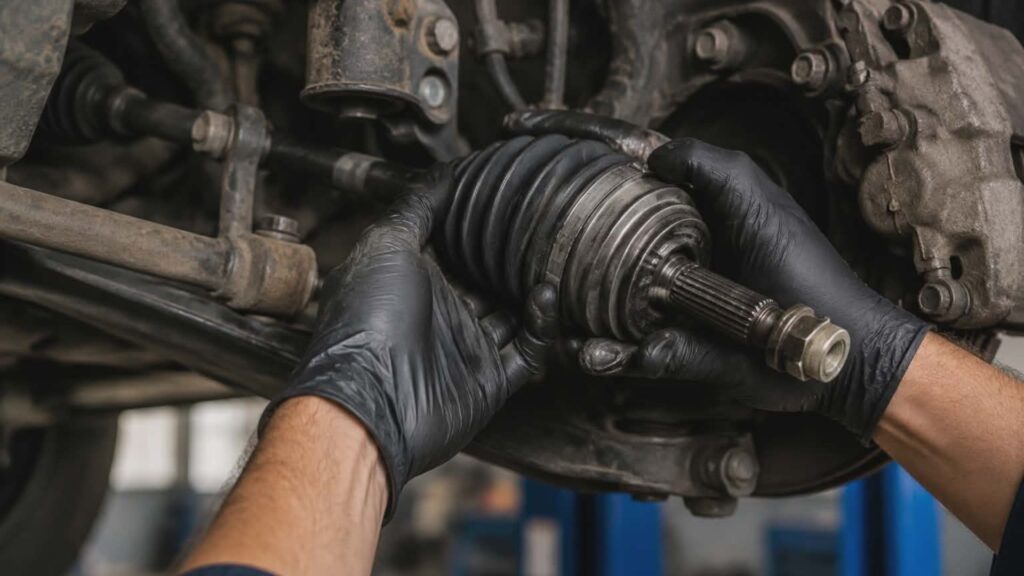
CV stands for constant velocity. A CV joint is part of the axle assembly that helps transfer power from the transmission to the wheels while allowing the wheels to move with steering and suspension changes.
CV joints are commonly found in front-wheel-drive and all-wheel-drive vehicles. Because these joints constantly move as you steer and drive over uneven roads, they can wear over time.
Why Do You Hear Clicking When Turning?
A worn outer CV joint is a common cause of clicking or popping sounds during turns. The outer joint sits closest to the wheel and handles significant movement as the vehicle changes direction.
As the joint wears, the internal components may no longer move smoothly. During a sharp turn, the added angle and pressure can cause worn parts to make a noticeable clicking or popping sound.
Although clicking during turns is commonly associated with CV joint wear, other front-end components can also cause unusual noises. A proper inspection is the best way to identify the source.
Why Can the Sound Get Worse During Sharp Turns?
During a sharp turn, the outer CV joint operates at a greater angle than it does while driving straight. If the joint already has wear or excess play, that additional movement can make the sound more noticeable.
You may hear little or no noise while driving on a straight road, but the clicking may become clear when making a tight turn, pulling into a parking space, or turning at low speeds.
The Role of the CV Boot
One common cause of CV joint wear is loss of lubrication. The CV boot is a rubber cover that keeps grease inside the joint while helping prevent dirt, moisture, and debris from entering.
When the boot tears or cracks, grease can leak out, and contaminants can enter the joint. You may notice grease around the wheel well or along the axle shaft, which may indicate a damaged boot.
A torn boot does not necessarily mean the joint has already failed. However, the joint may wear more quickly if the boot is not repaired promptly. If clicking has already developed, the joint itself may have sustained damage.
Signs of a Bad CV Axle You Should Not Ignore
Clicking during turns is one of the most recognizable signs of CV joint wear, but a failing CV axle may cause other symptoms as well.
- Vibration during acceleration: A damaged axle or inner CV joint may cause noticeable vibration as the vehicle accelerates.
- Clunking or knocking when accelerating from a stop: This may point to wear in an inner CV joint or another drivetrain component.
- Clicking during low-speed turns: Repetitive clicking while turning may indicate outer CV joint wear.
- Grease around the inside of the wheel: This may indicate that the CV boot is torn or leaking.
If you notice one or more of these signs, schedule an inspection rather than continuing to drive without knowing the cause. A failing CV axle can eventually affect drivability and may leave you unable to safely operate the vehicle.
Is It a CV Joint or Something Else?
Not every sound during a turn comes from a CV joint. A worn wheel bearing may create a humming, growling, or grinding sound that changes while driving. Brake components, suspension parts, and steering components can also cause unusual noises.
Online videos and parts-store research may help you understand possible causes, but they cannot replace a hands-on inspection. A trained mechanic can examine the axle, CV joints, boots, wheel bearings, brakes, and nearby components to determine what is actually causing the noise.
At Grewal’s Automotive in Indianapolis, the team can inspect your vehicle and recommend repairs based on the condition of the affected parts.
When Should You Replace the CV Axle?
If a CV boot is damaged but the joint has not developed noise or wear, repairing the boot may be an option in some cases. However, once the joint begins clicking during turns, installing a new boot may not solve the problem because the internal components may already be worn.
When significant CV joint wear is present, replacing the CV axle assembly is often the practical repair option. A professional technician can explain the condition of the axle and help you choose suitable replacement parts for your vehicle and budget.
Schedule CV Axle Repair in Indianapolis
A clicking sound while turning should not be ignored. It may indicate a worn CV joint, damaged boot, or another front-end problem that requires attention. The earlier the issue is inspected, the better your chances of preventing additional wear and unexpected repair costs.
If you are in Indianapolis and hear clicking or popping when turning, bring your vehicle to Grewal’s Automotive for a thorough inspection. Call 317-886-7501 to have your vehicle checked without disrupting your schedule.