
You hear it every time you get up to highway speed. A low, steady growl or hum that seems to be coming from somewhere beneath the car. You turn up the radio. It gets worse. You try to ignore it. It does not go away.
That sound is trying to tell you something, and the message is not good. There is a solid chance you are dealing with a bad wheel bearing, and the longer you wait, the worse it gets.
What Is a Wheel Bearing, Anyway?
A wheel bearing is a set of steel balls or rollers packed inside a metal ring, called a race. It sits inside the wheel hub and allows your wheel to spin freely with minimal friction. Every wheel on your vehicle has one.
Think of it like the silent workhorse behind every rotation your tires make. When it is working correctly, you never notice it. When it starts to fail, it makes itself very hard to ignore.
The Most Common Bad Wheel Bearing Symptoms
Not every grinding noise means a bad wheel bearing, but there are specific patterns that point directly to this problem. Here is what to watch for.
That Growling or Humming Sound
The most classic bad wheel bearing symptom is a growling or humming noise that changes with vehicle speed. It typically starts around 40 to 50 miles per hour and gets louder as you accelerate. Unlike a tire noise, it often shifts in pitch when you slightly change lanes or make a wide, gradual turn.
If the noise gets louder when you steer to the left, the problem is likely the right front bearing. If it gets louder when you steer right, suspect the left side. This happens because the weight shifts and increases load on the opposite bearing.
Grinding When Turning
A worn bearing can also produce a grinding sound, especially during low-speed turns like pulling into a parking lot or navigating a tight corner. This grinding typically means the bearing has lost lubrication and the metal components are making direct contact with each other.
Do not confuse this with brake grinding, which tends to be more immediate and happens only when braking. A bearing grind often accompanies the turn itself, not just the stopping.
Steering That Feels Loose or Vague
Your steering wheel should feel solid and responsive. If it starts to feel a little disconnected, wobbly, or imprecise, a bad wheel bearing could be the reason. The bearing plays a role in keeping your wheel assembly properly seated, and when it deteriorates, it can create play in the steering that you feel through the wheel.
This is not just an annoyance. It affects your ability to control the car accurately, especially at speed.
Uneven Tire Wear
A failing wheel bearing can cause a wheel to sit at a slightly irregular angle, leading to uneven wear on one tire. If you are seeing wear patterns that do not match across all four tires, it is worth having a technician check both the bearing and the wheel alignment.
Uneven wear is a symptom that many drivers catch late because they are not inspecting their tires regularly. Making it a habit during routine tire inspections can save you from a much bigger problem.
Vibration in the Steering Wheel or Floor
Vibration that you feel through the steering wheel or floorboard, particularly at certain speeds, can also point to a worn bearing. It may feel similar to a tire balance problem, but a balancing issue typically smooths out at very high speeds. Bearing vibration tends to be more persistent and often gets progressively worse over time.
Why a Bad Wheel Bearing Gets Dangerous Fast
A wheel bearing does more than reduce friction. It structurally supports the weight of your vehicle at the wheel. When it fails completely, the wheel can wobble, seize, or in extreme cases, separate from the vehicle entirely.
Even before it reaches that point, a failing bearing puts stress on nearby components – the hub assembly, the CV axle, the suspension, and the brakes. What starts as a $200 to $400 repair can snowball into a much larger job if it goes unaddressed.
The bottom line is that ignoring bad wheel bearing symptoms is not a money-saving strategy. It is the opposite.
How Technicians Diagnose a Bad Wheel Bearing
When you bring your car in for this kind of concern, a good technician will not just take your word for what you are hearing. They will do a proper diagnosis.
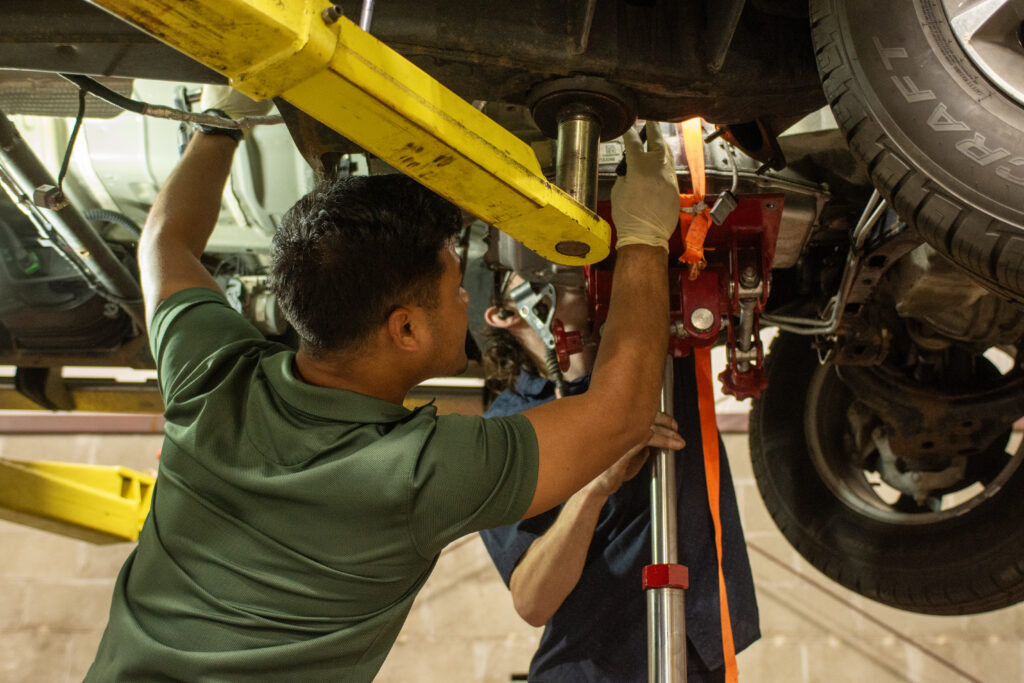
This typically involves a test drive to replicate the noise, followed by a physical inspection of each wheel. The technician will lift the vehicle and check for play in the wheel by grabbing it at the top and bottom and rocking it back and forth. Excessive movement confirms a problem with the hub or bearing.
They may also spin the wheel by hand and listen or feel for roughness. In some cases, a more advanced inspection of the hub assembly is needed to confirm the exact component at fault.
What the Repair Actually Involves
Replacing a wheel bearing is a moderately involved job. On most modern vehicles, the bearing is pressed into the hub or comes as part of a hub assembly unit. Either way, the wheel must come off, the hub has to be removed, and the bearing is either pressed out and a new one pressed in, or the entire hub assembly is replaced as a unit.
The suspension components in that corner of the vehicle are often disturbed during this process, which is why a wheel alignment check after the repair is a smart move. If any suspension components are moved or torqued differently, your alignment can shift, leading back to the very tire wear problems you were trying to avoid.
How Long Do Wheel Bearings Last?
Most wheel bearings are designed to last between 85,000 and 100,000 miles, but real-world conditions can cut that lifespan short. Driving on rough or pothole-heavy roads, exposure to water and road debris, and hard cornering all accelerate wear.
Indianapolis roads can be tough on vehicle components, especially during and after winter. Potholes, frost heaves, and the constant cycle of freezing and thawing put real stress on wheel assemblies. If you have put a lot of city miles on your car, it is worth being proactive about getting things checked.
Other Noises That Get Confused With a Bad Wheel Bearing
Not every worrying noise under your car is the bearing. Here are a few common mix-ups worth knowing about.
- Brake noise – A grinding or squealing from the brakes usually happens only when you apply the pedal. A bad bearing makes noise consistently based on speed and direction, not just when stopping.
- Tire noise – Cupped or worn tires can produce a humming sound that mimics a bearing. The difference is that tire noise tends to be more rhythmic and does not change noticeably when you shift your steering slightly from side to side.
- CV axle clicking – A worn CV joint often makes a clicking sound during tight turns, particularly when accelerating. This is distinct from the steady growl of a wheel bearing but can happen at the same time if both components are worn.
- Transmission or differential noise – These sounds often appear under load, when accelerating or decelerating, and may be harder to isolate without a proper inspection.
- If you are unsure what you are hearing, the safest move is to get a professional diagnosis rather than guess and wait.
Frequently Asked Questions About Wheel Bearing Problems
Can I drive with a bad wheel bearing?
Technically, yes – but you should not. A failing bearing can worsen rapidly, and in a complete failure, you risk losing control of the vehicle. If the noise is new and mild, you likely have some time to schedule a repair. If it is severe or accompanied by vibration and steering changes, get it looked at as soon as possible.
Will a bad wheel bearing affect my brakes?
Indirectly, yes. The wheel bearing is part of the hub assembly, and in some vehicles, the ABS sensor is mounted directly to the hub. A failing bearing can interfere with ABS sensor readings, triggering the ABS warning light and reducing braking effectiveness in emergency situations.
How do I know which wheel has the bad bearing?
The side-to-side steering test is a starting point. If the noise increases when turning right, the left bearing is usually at fault. If it increases when turning left, the right bearing is more likely the problem. A technician can confirm this with a hands-on inspection.
Is it possible for more than one bearing to fail at the same time?
It is not common, but it does happen, especially on vehicles with high mileage or a history of rough road use. If your car has been driven hard for many years, it is worth having all four corners checked during the same service visit.
When to Schedule a Wheel Bearing Inspection
Do not wait for the noise to become unbearable. If you have noticed any of the symptoms described here – humming at highway speeds, grinding on turns, loose steering, unusual vibration, or uneven tire wear – it is time to have the vehicle looked at by a qualified technician.
Getting ahead of a wheel bearing failure is much cheaper and safer than dealing with the aftermath of one.
Do Not Ignore Bad Wheel Bearing Symptoms
A growling noise from your wheels is not something to shrug off. Bad wheel bearing symptoms tend to get louder, not quieter, and they do not fix themselves. The team at Grewal’s Automotive in Indianapolis has the tools and experience to diagnose the problem correctly and get your vehicle back to running smoothly. If something feels or sounds off, schedule a suspension inspection and let a trained technician take a look. You can also call us at 317-886-7501 to set up an appointment.