
Your car depends on a precise balance of air and fuel to run properly. At the center of that balance is a small but critical component called the mass air flow sensor, or MAF sensor. When it starts to fail, your engine can behave in all kinds of frustrating ways – and most drivers have no idea what’s causing it.
If your vehicle has been acting strange lately, a failing MAF sensor might be the root of the problem. Here are 10 common symptoms of a bad mass air flow sensor you should never brush off.
What Does a Mass Air Flow Sensor Do?
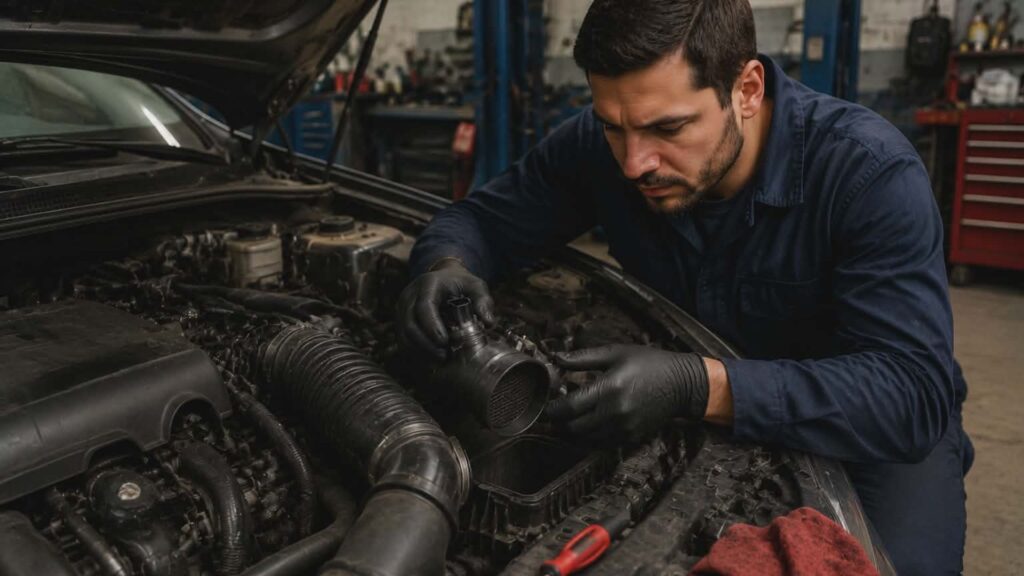
The mass air flow sensor measures the amount of air entering the engine so the engine control module (ECM) knows how much fuel to inject. Accurate airflow data is essential because the ECM uses it to maintain the correct air-fuel ratio for efficient combustion.
When the MAF sensor sends inaccurate data to the ECM, the engine receives either too much or too little fuel. That mismatch can cause a wide range of drivability and performance problems throughout the vehicle.
10 Common Symptoms of a Bad MAF Sensor
Check Engine Light Turns On
One of the first signs that something is wrong is a check engine light (CEL) on your dashboard.
When the MAF sensor fails or sends bad data, the engine control unit logs diagnostic trouble codes related to airflow measurement.
A CEL alone does not always point to a MAF sensor, which is why professional engine computer diagnostics are so important. A trained technician can pull the codes and confirm whether the MAF is causing trouble.
Rough Idling
If your engine shakes or sputters when sitting at stoplights or in a parking lot, a bad MAF sensor could be responsible. When the sensor causes the ECM to miscalculate the fuel mixture, the engine struggles to maintain a smooth idle.
This issue is often confused with spark plug problems or a vacuum leak. If you want to understand more, check out this guide on the common causes of a rough idle and see how airflow issues fit into the picture.
Hesitation During Acceleration
Engine hesitation is a classic sign of MAF sensor problems. You press the gas pedal, and the car seems to pause, stumble, or jerk before responding. That hesitation during acceleration happens because the sensor is not accurately measuring the airflow, so the ECM cannot deliver the correct amount of fuel fast enough.
This is especially noticeable when merging onto a highway or pulling out of an intersection. If your car feels sluggish, a failing MAF sensor might be why.
Engine Stalling
A bad MAF sensor can cause your engine to stall, especially at low speeds or right after starting. When the sensor fails to measure airflow accurately, the combustion chamber does not get the fuel balance it needs to keep running.
Stalling at idle or right after startup is a red flag worth investigating immediately. Letting it go unchecked can lead to costly repairs down the road.
Poor Fuel Economy
If you are filling up your tank more often than usual, your MAF sensor may be going bad. When the sensor sends inaccurate readings, the ECM may inject too much fuel to compensate, which tanks your fuel economy and wastes gas.
Poor fuel efficiency is easy to ignore since it creeps up gradually. But if your fuel costs have gone up without any changes to your driving habits, your airflow sensor deserves a closer look.
Difficulty Starting the Engine
Difficulty starting is another symptom of a bad mass air flow sensor. If the ECM does not know how much air is entering the engine, it cannot calculate the right amount of fuel to inject during startup.
This can lead to a car that cranks without starting, or one that takes several attempts to turn over. Cold mornings can make this even worse.
Engine Misfires
A faulty MAF sensor can throw off the air-fuel mixture enough to cause misfires. When the combustion process is disrupted by incorrect airflow data, some cylinders may not fire properly.
Misfires can feel like a shudder, vibration, or sudden power loss. Understanding what causes an engine misfire can help you connect the dots between a bad MAF and what you feel behind the wheel.
Car Shakes at Idle
When MAF sensor problems affect the air-fuel ratio at low RPMs, you might notice your car vibrating or shaking while sitting still. This is related to rough idling but tends to be more pronounced and uncomfortable.
If you have been wondering why your car shakes at idle, a bad MAF sensor is one of the more common culprits worth checking early.
Sluggish Performance Under Load
A faulty MAF sensor can cause noticeable power loss when your vehicle is under stress – like when you tow something heavy or push hard on the highway. The engine needs accurate airflow data to deliver the right power during highway or towing conditions.
When the sensor is bad, the ECM cannot optimize combustion for the extra demand. The result is a vehicle that struggles where it should perform with confidence.
Black Smoke from the Exhaust
Black smoke from your exhaust is a sign that the engine is burning too much fuel. This happens when the MAF sensor sends inaccurate readings that lead the ECM to over-fuel the engine, disrupting the air-fuel mixture.
Burning too much fuel is not just bad for engine performance; it can also hurt your emissions test results and damage other components over time.
What Causes MAF Sensor Failure?
Understanding the causes of MAF sensor problems can help you prevent them. The most common culprits include:
- Contaminants like dirt, dust, or oil coating the sensor wire
- Connection issues such as damaged wiring or corroded connectors
- A clogged air filter that restricts the amount of airflow reaching the sensor
- Debris from a torn intake boot is entering the airflow path
Cleaning the MAF sensor with a dedicated spray cleaner can temporarily improve performance, but it is not a permanent fix if the sensor is bad or the wiring is damaged. Replacing a dirty air filter regularly also helps protect the MAF sensor’s longevity.
How to Tell If Your Mass Air Flow Sensor Is the Problem
A diagnostic scan is the most reliable way to confirm if the air flow sensor is bad. Codes like P0100 through P0104 point directly to mass air flow sensor problems. Some drivers check these codes using a handheld reader, which can give you a starting point – but a full diagnostic is still recommended to rule out other issues.
For a more thorough evaluation, comprehensive engine repair services from a certified technician will help you get to the bottom of what is actually going on with your vehicle.
Conclusion
A bad MAF sensor can cause a surprising range of problems, from rough idling and engine hesitation to poor fuel economy and engine stalling. The longer you ignore these symptoms, the more strain it puts on your engine and your wallet. If your car has been acting up and you are in Indianapolis, the team at Grewal’s Automotive is ready to help. Call 317-886-7501 to schedule a diagnostic and fix the problem before it gets worse.