
If your car has been running rough lately, you might have heard someone mention the ignition coil or the spark plug as the likely culprit. But what exactly do these parts do, and how are they different from each other? Understanding the basics can save you time, money, and a lot of guesswork.
How Your Car’s Ignition System Actually Works
Every internal combustion engine needs three things to run: fuel, air, and a spark. The ignition system is responsible for delivering that spark at exactly the right moment, and both the ignition coil and spark plug play a critical role in making that happen.
Think of it as a two-step process. First, the coil builds up the electricity. Then, the spark plug delivers it.
What Does an Ignition Coil Do?
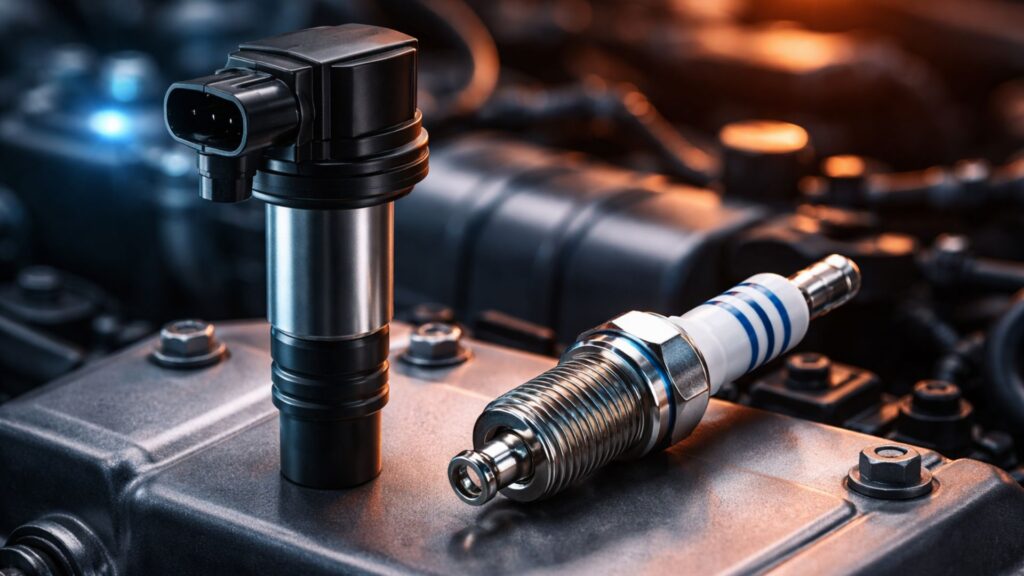
The ignition coil is essentially a transformer. The ignition coil transforms the battery’s low voltage, which is typically around 12 volts, into the high voltage needed to create a spark. That output can range anywhere from 12,000 to 45,000 volts, depending on the engine.
That coil voltage surge travels through spark plug wires or directly through a coil pack to reach each spark plug. In modern vehicles, many engines use individual coils for each cylinder, which gives better control over combustion timing and engine performance.
What Does a Spark Plug Do?
Once the high-voltage electrical pulse arrives, the spark plug takes over. Its job is to generate an electric spark in the spark plug’s gap, which ignites the air-fuel mixture inside the combustion chamber. That small but powerful spark ignites the fuel and drives the piston down, creating the power your car runs on.
Spark plugs also help manage the heat range inside the engine. They are designed to transfer heat away from the combustion chamber and into the cylinder head, keeping temperatures balanced during normal operation.
Coil Vs Spark Plug: What’s the Difference?
Here is the simplest way to think about it: the ignition coil and spark plug are teammates, not competitors. The coil builds high-voltage electricity, and the spark plug uses it to ignite the air-fuel mixture in the engine’s cylinders. One cannot do one’s job without the other.
A bad ignition coil means the spark plug never gets the voltage it needs to create a spark. A bad spark plug means that even with perfect coil voltage, the combustion never happens correctly.
Either way, your engine suffers.
Symptoms of a Bad Coil or Bad Spark Plug
It can be hard to tell these two apart without a proper diagnosis. That said, there are some patterns worth knowing.
A faulty coil often causes engine misfires, a rough idle, or noticeable power loss. You might also notice poor fuel economy because unburned fuel mixture passes through the engine and can even damage the catalytic converter over time. If you want a deeper look, check out these warning signs of a failing ignition coil.
A bad spark plug tends to cause similar symptoms, such as engine knocking, sluggish acceleration, or a rough idle. Plugs wear down gradually, so the decline in engine performance can be slow and easy to miss. Learn more about the common symptoms of bad spark plugs so you know what to watch for.
It is also worth understanding what causes an engine misfire, since both a faulty coil and worn plugs are frequent triggers. And if your car is shaking at a stoplight, reviewing the most common causes of rough idle can help narrow things down.
Should You Replace Both at the Same Time?
This is a smart question. Since spark plugs and ignition coils work together, replacing one while leaving the other worn can lead to repeated problems. Many mechanics recommend replacing both during the same service visit to protect new components from being stressed by worn ones. Read more about whether you should replace ignition coils when changing spark plugs before your next appointment.
A scan tool and ignition system inspection can also help identify whether it is the coil, the plug, or even an oxygen sensor causing the issue.
If you’re unsure, it’s best to check with an auto repair professional.
Conclusion
Understanding the difference between an ignition coil and a spark plug helps you make smarter decisions about your vehicle maintenance. Whether you are dealing with a misfire, a rough idle, or reduced fuel efficiency, knowing which part to suspect as well as when to replace both keeps your car’s engine running reliably.
If you are not sure where to start, the team at Grewal’s Automotive in Indianapolis is ready to help.